The Cross Product

Given the two vectors below, their cross product \(\vec{v} \times \vec{w}\) is defined as below.

\[ \begin{aligned} \vec{v} &= v_1\mathbf{i} + v_2\mathbf{j} + v_3\mathbf{k} \\ \vec{w} &= w_1\mathbf{i} + w_2\mathbf{j} + w_3\mathbf{k} \end{aligned} \]

Cross Product

\[ \begin{aligned} \vec{v} \times \vec{w} &= (v_2 w_3 - v_3 w_2)\mathbf{i} \\ &\qquad {}+ (v_3 w_1 - v_1 w_3)\mathbf{j} \\ &\qquad {}+ (v_1 w_2 - v_2 w_1)\mathbf{k} \end{aligned} \]

Idea: A common way to remember this is as the determinant of the matrix below.

\[ \vec{v} \times \vec{w} = \begin{vmatrix} \mathbf{i} & \mathbf{j} & \mathbf{k} \\ v_1 & v_2 & v_3 \\ w_1 & w_2 & w_3 \end{vmatrix} \]

An Example

Given the vectors \(\vec{v} = \langle 2, 2, 2 \rangle\) and \(\vec{w} = \langle 3, 5, 4 \rangle\), find \(\vec{v} \times \vec{w}\).

\[ \begin{aligned} \vec{v} &= 2\mathbf{i} + 2\mathbf{j} + 2\mathbf{k} \\ \vec{w} &= 3\mathbf{i} + 5\mathbf{j} + 4\mathbf{k} \end{aligned} \]
\[ \begin{aligned} \vec{v} \times \vec{w} &= (2 \cdot 4 - 2 \cdot 5)\mathbf{i} \\ &\qquad {}+ (2 \cdot 3 - 2 \cdot 4)\mathbf{j} \\ &\qquad {}+ (2 \cdot 5 - 2 \cdot 3)\mathbf{k} \\ &= -2\mathbf{i} - 2\mathbf{j} + 4\mathbf{k} \\ &= \langle -2, -2, 4 \rangle \end{aligned} \]

Note: The cross product yields a vector! It is sometimes called the vector product.

For the standard basis vectors, the following are true.

Cross products of the standard basis vectors
\(\mathbf{i} \times \mathbf{i} = \mathbf{0}\)\(\mathbf{i} \times \mathbf{j} = \mathbf{k}\)\(\mathbf{j} \times \mathbf{i} = -\mathbf{k}\)
\(\mathbf{j} \times \mathbf{j} = \mathbf{0}\)\(\mathbf{j} \times \mathbf{k} = \mathbf{i}\)\(\mathbf{i} \times \mathbf{k} = -\mathbf{j}\)
\(\mathbf{k} \times \mathbf{k} = \mathbf{0}\)\(\mathbf{k} \times \mathbf{i} = \mathbf{j}\)\(\mathbf{k} \times \mathbf{j} = -\mathbf{i}\)

A good homework problem is to verify these properties. Let’s confirm \(\mathbf{i} \times \mathbf{k} = -\mathbf{j}\).

Use the cross product formula with \(\vec{v} = \mathbf{i}\) and \(\vec{w} = \mathbf{k}\).

\[ \begin{aligned} \mathbf{i} &= \langle 1, 0, 0 \rangle \\ \mathbf{k} &= \langle 0, 0, 1 \rangle \end{aligned} \]
\[ \begin{aligned} \mathbf{i} \times \mathbf{k} &= (v_2 w_3 - v_3 w_2)\mathbf{i} \\ &\qquad {}+ (v_3 w_1 - v_1 w_3)\mathbf{j} \\ &\qquad {}+ (v_1 w_2 - v_2 w_1)\mathbf{k} \\ &= (0 \cdot 1 - 0 \cdot 0)\mathbf{i} \\ &\qquad {}+ (0 \cdot 0 - 1 \cdot 1)\mathbf{j} \\ &\qquad {}+ (1 \cdot 0 - 0 \cdot 0)\mathbf{k} \\ &= 0\mathbf{i} - 1\mathbf{j} + 0\mathbf{k} \\ &= -\mathbf{j} \end{aligned} \]

For vectors \(\vec{u}\), \(\vec{v}\), and \(\vec{w}\), and a scalar \(a\), the following are true.

\[ \vec{v} \times \vec{v} = \vec{0} \]
\[ \vec{v} \times \vec{w} = -(\vec{w} \times \vec{v}) \]
\[ a(\vec{v} \times \vec{w}) = (a\vec{v}) \times \vec{w} = \vec{v} \times (a\vec{w}) \]
\[ \vec{u} \times (\vec{v} + \vec{w}) = \vec{u} \times \vec{v} + \vec{u} \times \vec{w} \]
\[ \|\vec{v} \times \vec{w}\|^2 = \|\vec{v}\|^2\,\|\vec{w}\|^2 - (\vec{v} \dotp \vec{w})^2 \]

For nonzero vectors \(\vec{v}\) and \(\vec{w}\), the following are true.

  • If \(\theta\) is the angle between the vectors, then \(\|\vec{v} \times \vec{w}\| = \|\vec{v}\|\,\|\vec{w}\|\sin\theta\).
  • \(\vec{v} \times \vec{w}\) is perpendicular to both \(\vec{v}\) and \(\vec{w}\).
  • \(\vec{v} \times \vec{w} = \vec{0}\) if and only if \(\vec{v}\) and \(\vec{w}\) are parallel.
  • The parallelogram with adjacent sides \(\vec{v}\) and \(\vec{w}\) has area \(\|\vec{v} \times \vec{w}\|\).
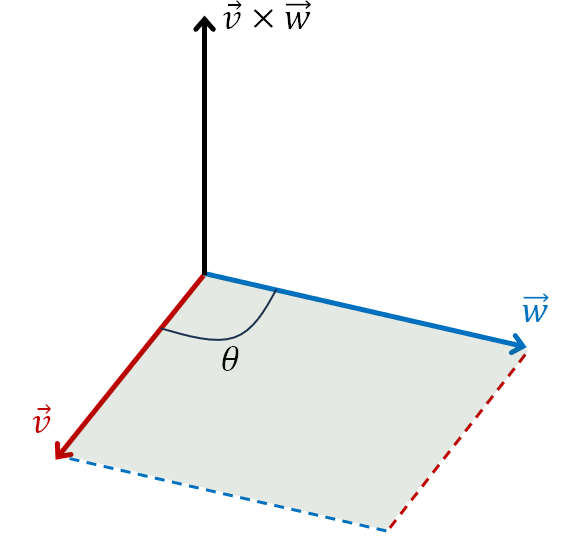
Vectors v and w forming a shaded parallelogram with the angle theta between them, and the vector v cross w pointing straight up, perpendicular to both.

An Example

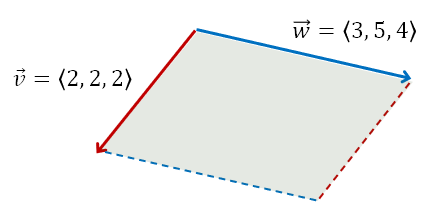
Find the area of the parallelogram having adjacent sides \(\vec{v} = \langle 2, 2, 2 \rangle\) and \(\vec{w} = \langle 3, 5, 4 \rangle\), shown in the figure.

Idea: From one of the properties of the cross product, this area is equal to the magnitude of the cross product.

\[ \begin{aligned} \vec{v} \times \vec{w} &= (v_2 w_3 - v_3 w_2)\mathbf{i} \\ &\qquad {}+ (v_3 w_1 - v_1 w_3)\mathbf{j} \\ &\qquad {}+ (v_1 w_2 - v_2 w_1)\mathbf{k} \\ &= (2 \cdot 4 - 2 \cdot 5)\mathbf{i} \\ &\qquad {}+ (2 \cdot 3 - 2 \cdot 4)\mathbf{j} \\ &\qquad {}+ (2 \cdot 5 - 2 \cdot 3)\mathbf{k} \\ &= \langle -2, -2, 4 \rangle \end{aligned} \]
\[ \begin{aligned} \|\vec{v} \times \vec{w}\| &= \sqrt{(-2)^2 + (-2)^2 + 4^2} \\ &= \sqrt{24} \\ &= 2\sqrt{6} \end{aligned} \]

The area is \(2\sqrt{6}\).

A shaded parallelogram with adjacent sides v equals 2, 2, 2 and w equals 3, 5, 4.