Unit Vectors and Standard Basis Vectors

A unit vector is a vector with a magnitude of one.

An Example

Find the magnitude of the vector below. Then determine if the vector is a unit vector.

\[ \vec{v} = \langle 1, 1, 1 \rangle \]

The magnitude of a position vector in \(\mathbb{R}^3\) is the result of the formula below. This follows from the distance formula. It is the distance from the origin to the point \((v_1, v_2, v_3)\).

\[ \begin{aligned} \|\vec{v}\| &= \sqrt{v_1^2 + v_2^2 + v_3^2} \\ &= \sqrt{1^2 + 1^2 + 1^2} \\ &= \sqrt{3} \end{aligned} \]

Because the magnitude is not one this is not a unit vector.

An Example

Find the magnitude of the vector below. Then determine if the vector is a unit vector.

\[ \vec{v} = \langle 0.6, 0.8 \rangle \]

The magnitude of a position vector in \(\mathbb{R}^2\) is the result of the formula below. This follows from the distance formula. It is the distance from the origin to the point \((v_1, v_2)\).

\[ \begin{aligned} \|\vec{v}\| &= \sqrt{v_1^2 + v_2^2} \\ &= \sqrt{0.6^2 + 0.8^2} \\ &= \sqrt{0.36 + 0.64} \\ &= 1 \end{aligned} \]

Because the magnitude is one this is a unit vector.

Given a nonzero vector \(\vec{v}\), this is the process of finding a new vector, with the same direction as \(\vec{v}\) but with a magnitude of one. To normalize a vector, we divide the vector by its magnitude.

The unit vector in the direction of \(\vec{v}\) is often written \(\hat{v}\).

Unit Vector in the Direction of \(\vec{v}\)

\[ \hat{v} = \frac{\vec{v}}{\|\vec{v}\|} \]

An Example

Normalize the below vector.

\[ \vec{v} = \langle 2, 4, 8 \rangle \]
\[ \begin{aligned} \frac{\vec{v}}{\|\vec{v}\|} &= \frac{\vec{v}}{\sqrt{v_1^2 + v_2^2 + v_3^2}} \\ &= \frac{\langle 2, 4, 8 \rangle}{\sqrt{2^2 + 4^2 + 8^2}} \\ &= \frac{\langle 2, 4, 8 \rangle}{\sqrt{84}} \\ &= \frac{\langle 2, 4, 8 \rangle}{2\sqrt{21}} \\ &= \frac{\langle 1, 2, 4 \rangle}{\sqrt{21}} \\ &= \frac{\sqrt{21}}{21}\langle 1, 2, 4 \rangle \\ &= \left\langle \frac{\sqrt{21}}{21},\ \frac{2\sqrt{21}}{21},\ \frac{4\sqrt{21}}{21} \right\rangle \end{aligned} \]

These are the unit vectors in the direction of the positive coordinate axes. They are written in several ways, including with hats, which is common in physics.
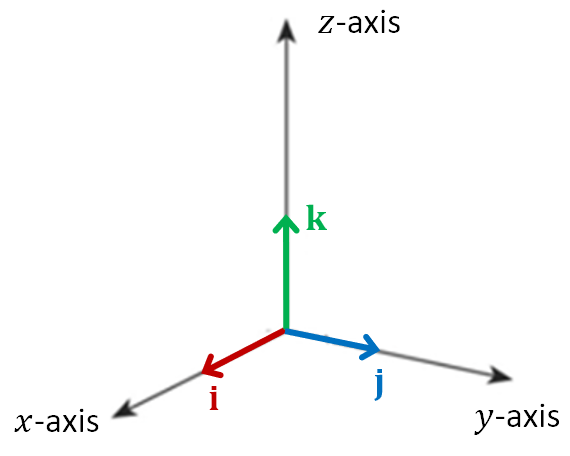
\[ \begin{aligned} \vec{i} = \mathbf{i} = \hat{\imath} &= \langle 1, 0, 0 \rangle \\ \vec{j} = \mathbf{j} = \hat{\jmath} &= \langle 0, 1, 0 \rangle \\ \vec{k} = \mathbf{k} = \hat{k} &= \langle 0, 0, 1 \rangle \end{aligned} \]
Three-dimensional axes with the unit vectors i, j, and k pointing along the positive x-, y-, and z-axes.

Write the vector \(2\mathbf{i} + 3\mathbf{j} - 4\mathbf{k}\) in angle bracket notation.

\[ \begin{aligned} &2\mathbf{i} + 3\mathbf{j} - 4\mathbf{k} \\ &\quad = 2\langle 1, 0, 0 \rangle + 3\langle 0, 1, 0 \rangle \\ &\qquad\quad {}- 4\langle 0, 0, 1 \rangle \\ &\quad = \langle 2, 0, 0 \rangle + \langle 0, 3, 0 \rangle \\ &\qquad\quad {}- \langle 0, 0, 4 \rangle \\ &\quad = \langle 2, 3, -4 \rangle \end{aligned} \]

Notice the coefficients of the standard basis vectors are the components of the vector.

Given the below, find \(\vec{v} + \vec{w}\).

\[ \begin{aligned} \vec{v} &= 2\mathbf{i} + 3\mathbf{j} - 4\mathbf{k} \\ \vec{w} &= 6\mathbf{i} - 7\mathbf{j} + 5\mathbf{k} \end{aligned} \]

Recall: We add vectors by combining the corresponding components.

\[ \begin{aligned} \vec{v} + \vec{w} &= (2 + 6)\mathbf{i} + (3 - 7)\mathbf{j} \\ &\qquad {}+ (-4 + 5)\mathbf{k} \\ &= 8\mathbf{i} - 4\mathbf{j} + \mathbf{k} \end{aligned} \]